Can You Use Floor Cleaner on Walls? What You Should Know
Ever find yourself in the middle of a cleaning spree, holding your favorite floor cleaner, and wondering, “Can I use floor cleaner on my walls, too?”
You’re not alone!
When you’re already cleaning your floors, it can be tempting to use the same cleaner and mop to tackle fingerprints, scuff marks, and smudges on nearby walls.
But before you start cleaning from floor to ceiling, there’s something important to know.
Floor cleaners aren’t automatically suitable for painted walls. Whether a cleaning product can be used on another surface depends on its ingredients, the surface material, and the manufacturer’s instructions.
Let’s explore what works, what to avoid, and how to keep your walls looking beautiful without damaging the paint.
Can You Use Floor Cleaner on Painted Walls?
Generally, it’s best to use a cleaning product specifically recommended for your wall’s paint or surface finish.
Although some floor cleaners may be compatible with certain hard surfaces, that doesn’t mean they’re appropriate for every painted wall.
Painted drywall, wallpaper, tile, and wood paneling all have different cleaning requirements.
Using an incompatible cleaner could cause:
- Streaking or visible residue
- Changes in paint sheen
- Discoloration
- Moisture damage
- Damage to delicate wall finishes
Before using any cleaning product on your walls, check both the cleaner’s label and the wall-finish manufacturer’s recommendations.
Quick Shine® floor cleaners are formulated for compatible flooring surfaces. Their floor-care benefits shouldn’t be assumed to apply to painted walls.
What Is the Best Way to Clean Painted Walls?
For many washable painted walls, a soft microfiber cloth lightly dampened with water is a good starting point, provided the paint manufacturer permits it.
Step 1: Remove Loose Dust
Use a clean, dry microfiber cloth or soft duster to remove dust and cobwebs.
Pay particular attention to corners, baseboards, and areas around doorframes.
Step 2: Check Your Paint Finish
Different paint finishes respond differently to cleaning.
Gloss and semi-gloss finishes are often more washable than flat or matte finishes, but durability varies by paint formulation.
Always follow the paint manufacturer’s care instructions.
Step 3: Test a Small Area
Before cleaning a noticeable section, test your method in an inconspicuous location.
Allow the area to dry completely and check for changes in color or sheen.
Step 4: Clean Gently
Use a soft, lightly dampened microfiber cloth.
Avoid aggressive scrubbing, which may remove paint or create shiny patches.
Step 5: Remove Excess Moisture
Don’t saturate painted drywall.
Use a clean cloth to remove excess moisture and allow the surface to dry.
Can You Use a Microfiber Mop to Clean Walls?
A microfiber mop can be a convenient tool for removing dust from large wall surfaces, especially in areas that are difficult to reach by hand.
However, not every mop or attachment is intended for vertical surfaces.
If your mop manufacturer approves wall cleaning:
- Use a clean microfiber pad.
- Start with dry dusting.
- Avoid applying excessive pressure.
- Keep moisture to a minimum.
- Never spray cleaning solutions near electrical outlets or switches.
For painted walls, a soft microfiber cloth is often the simplest choice for removing individual smudges.
A Cleaning Experiment: Using Quick Shine Hardwood Floor Cleaner on a Wall
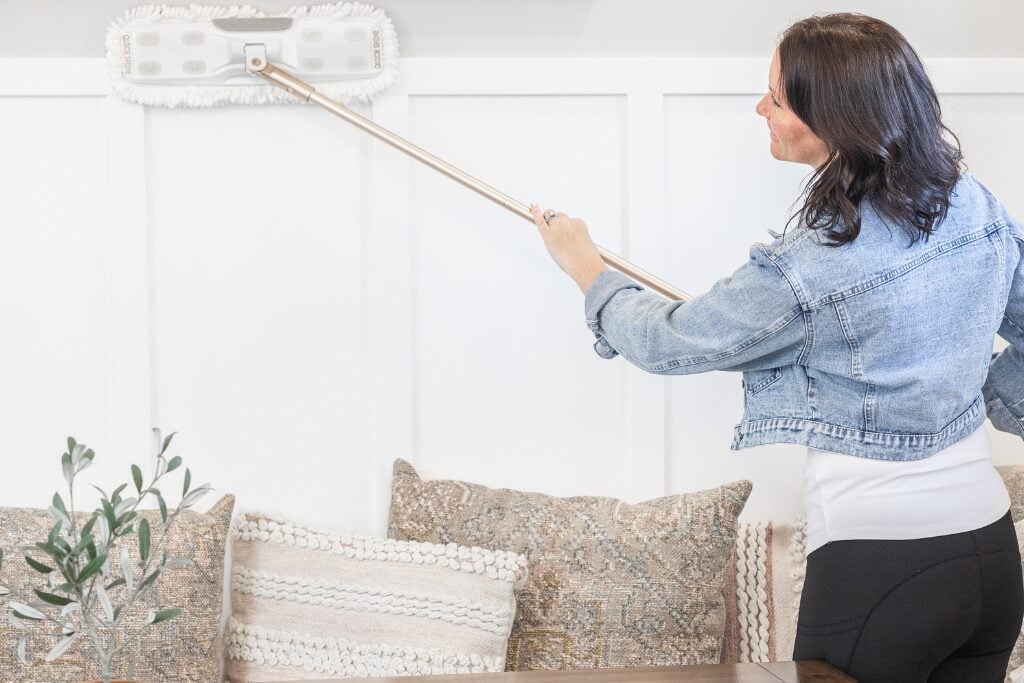
Sometimes the best cleaning questions come from everyday experiences.
While cleaning a hallway, I wondered whether the microfiber pad I was already using could help remove a few smudges from the painted wall.
I tried a small area using Quick Shine® Hardwood Floor Cleaner on a lightly dampened microfiber pad.
In that particular instance, the marks came away without noticeable streaking.
It was a satisfying cleaning moment!
However, one successful spot-cleaning experience doesn’t establish that a floor cleaner is compatible with every painted surface.
Paint formulas, wall finishes, and cleaning conditions vary.
For routine wall cleaning, follow the paint manufacturer’s recommendations and use products approved for the surface.
Can You Use a Mop to Clean Ceilings?
Here’s another question you might have considered during a deep-cleaning session!
A lightweight microfiber duster or an extension tool designed for overhead dusting can help remove cobwebs from ceiling corners.
However, avoid using wet floor-cleaning equipment overhead unless the tool is specifically designed and approved for that purpose.
Ceiling materials can be particularly sensitive to moisture.
For example, textured or popcorn-style ceilings may be damaged by wet cleaning or excessive pressure.
Helpful tip: Use a dry microfiber attachment or a ceiling-safe duster for routine cobweb removal.
Can You Use Floor Polish on Furniture?
No. Floor polish should not be used as a substitute for furniture polish.
Products such as Quick Shine® Multi-Surface Floor Finish and Quick Shine® Hardwood Floor Luster are formulated for compatible flooring surfaces.
Furniture finishes have different requirements.
Applying floor polish to tables, cabinets, or other furniture could produce undesirable results or interfere with the existing finish.
Always choose products intended for the surface you’re maintaining.
What’s the Difference Between Multi-Surface Floor Cleaner and All-Purpose Cleaner?
The term multi-surface can sometimes create confusion.
A multi-surface floor cleaner is designed for a range of compatible flooring materials.
An all-purpose cleaner may be formulated for a different range of household surfaces, depending on its label.
For example, Quick Shine® Multi-Surface Floor Cleaner is designed for routine cleaning of compatible sealed hard-surface floors.
Its benefits include:
- EPA Safer Choice Certified
- PFAS Free
- pH neutral
- Rinse-free
- Powered by Baking Soda
These benefits don’t automatically mean the cleaner is suitable for painted drywall, furniture, or other non-floor surfaces.
The product label—not just the product name—should guide where and how you use a cleaner.
Frequently Asked Questions About Cleaning Walls
Can I Use Hardwood Floor Cleaner on Painted Walls?
Hardwood floor cleaners are formulated for compatible flooring surfaces. Unless the product manufacturer and paint manufacturer approve the use, choose a cleaner specifically recommended for your painted walls.
Can I Clean Walls With Just Water and a Microfiber Cloth?
For many washable painted surfaces, a lightly dampened microfiber cloth can help remove dust and minor smudges. Always test an inconspicuous area first and avoid excessive moisture.
Can I Use a Spray Mop on Walls?
Only use a spray mop on walls if the equipment manufacturer specifically permits vertical use and the cleaning method is appropriate for the wall surface. Avoid spraying liquids near electrical fixtures.
What’s the Best Way to Remove Scuff Marks From Painted Walls?
Start with a clean microfiber cloth and a gentle cleaning method approved by your paint manufacturer. Avoid abrasive scrubbing, which may damage the finish.
Can I Use Floor Finish to Make My Walls Shiny?
No. Quick Shine floor polishes are formulated for compatible flooring surfaces and should not be applied to painted walls to create shine.
Does Quick Shine Floor Cleaner Disinfect Walls?
Quick Shine’s routine floor cleaners are intended for cleaning, not disinfecting. If disinfection is necessary, use an EPA-registered disinfectant labeled for the specific surface and follow its directions.
The Bottom Line: Use the Right Cleaner for the Right Surface
We love finding ways to make household cleaning easier, but using the right product for each surface is essential.
While a floor cleaner may seem like a convenient option for cleaning walls, not every floor-care formula is appropriate for painted surfaces.
For walls, follow the paint manufacturer’s care instructions.
For your floors, choose a cleaner designed for your flooring type.
Quick Shine offers convenient floor-care solutions, including:
- Quick Shine Multi-Surface Floor Cleaner for compatible sealed hard-surface floors.
- Quick Shine Hardwood Floor Cleaner for compatible finished hardwood flooring.
Both are EPA Safer Choice Certified and PFAS Free.
Have a floor-care question of your own?
Our Holloway House Customer Service team is happy to help.
Call: 1-800-255-1891
Hours: Monday–Friday, 8:00 AM–4:30 PM Eastern Time
Explore more cleaning tips and floor-care solutions at QuickShineFloors.com.
Ever fo
Can i use the, QUICK SHINE , HARDWOOD FLOOR LUSTER, on vinal floor covering.
Thank you
Hi William,
Absolutely! Quick Shine Hardwood Floor Luster is compatible with any hard surface flooring and is pH neutral.